

%20(1)%20(1).png)
Most SaaS founders treat their product launch like a single event. Build the product, push it live, post on Product Hunt, run some ads, and wait. That's not a SaaS product launch strategy. That's hoping.
A real launch strategy starts before you write a line of copy and runs for months after you go live. It covers who you're targeting, what you want them to do, how you reach them on your specific budget, and how you optimize once the first customers are in.
This guide covers all of it, step by step, and in order.
Lock in, you're about to blow up your SaaS.
Step 1: Determine Your Goal: Self-Serve Signups or Demo Bookings
Before you build a single page or write a single ad, you need to answer one question: what action do you want someone to take when they land on your site?
There are two options. Self-serve signups or demo bookings. These require completely different funnels, different messaging, and different success metrics. Trying to do both at launch splits your conversion rate and your attention.
Self-serve signups work best when your product solves a narrow, clearly defined problem the buyer can evaluate without talking to sales. Typically sub-$200/month per seat. Trial or freemium entry points.
Demo bookings work best when your deal size is over $500/month, the product needs configuration or onboarding, or the buyer needs to justify the purchase to a board. If you're going the demo route, read our full breakdown of why demo pages don't convert before you build yours.
Pick one. Build your entire SaaS launch strategy around that one action.
Step 2: Build Your Launch Strategy From Your Budget
Your tactics should match what you can actually spend. Most launch guides ignore this and recommend everything: paid ads, content, PR, influencers, Product Hunt, leaving founders to execute ten strategies at half-effort.
If you do that, nothing will convert.
Here's how to think about it by budget.
Low Budget (Under $2K/Month): DMs, Cold Email, and Content
Outbound is your highest-ROI channel when budget is tight. Cold email and DMs cost almost nothing to run, they're fast to test, and they put you in direct conversation with your ICP before you spend a dollar on ads.
The rule: pick one outbound channel and go deep. Cold email if you can build a verified list. LinkedIn Sales Navigator if you're B2B. Instagram DMs if your ICP is active there. More on execution in the Cold Outreach section below.
Alongside outbound, start building organic content. Post on LinkedIn. Start a YouTube channel. Document your build process (build in public kills on social media), share what you're learning about your ICP, publish answers to the questions your buyers are searching for. It won't drive traffic in week one, but it compounds and it makes your paid ads more effective when you eventually turn them on.
High Budget: Paid Ads
Paid ads let you move fast. You can reach thousands of qualified prospects without building an audience first. But paid ads only work when your funnel converts. Running ads to a homepage with no dedicated offer is burning budget to prove your site doesn't work.
If you're spending on ads at launch, you need a dedicated landing page built for one audience and one offer before you spend a dollar. More on this in the Landing Pages section.
The 3 Stages of a SaaS Product Launch
Every launch moves through three phases:
Pre-launch: Validate your market, define your ICP, build your MVP, and prepare your go-to-market strategy. This is where the real work happens. Most of what determines launch success is decided here. You're in this phase right now reading this.
Launch: Execute your marketing campaigns, onboard your first customers, monitor performance. This phase is shorter than most founders expect, but more intense.
Post-launch: Optimize based on data, iterate on feedback, and scale what's working. Most founders underinvest here. This is where predictable growth comes from.
Each stage is covered below.
Pre-Launch: The Foundation That Determines Everything
The quality of your pre-launch work determines whether launch day is a moment or a non-event. Do not skip or rush these steps.
Get Clear on Your ICP
Before you write a word of copy or design a single ad, you need to know exactly who your product is for. Not "marketing managers at mid-size B2B companies." Specific: "VP of Marketing at a Series A B2B SaaS company, 20-100 employees, running paid ads, frustrated because their CAC keeps climbing while conversion rate stays flat."
Even give your ICP a name. Our's is Steve.
The more specific your ICP, the easier every other decision becomes. Ad targeting, outreach list building, landing page headline, onboarding sequence, all of it flows from ICP clarity.
In fact, go as far is creating a "Master Messaging Doc" to act as your north start as you go through your launch phases.
Do In-Depth ICP Research Online Using Their Exact Words
Your ICP is already telling you what they need. You just have to find it.
Go to Reddit, LinkedIn, G2, Capterra, and your competitors' review pages. Search for the problem your product solves. Read what people are actually saying, not the polished language, but the raw, frustrated words. "I wasted three months on..." or "I wish there was a tool that just..."
These phrases become your headlines, ad copy, and landing page subheadings. Borrowed language converts because it sounds like you read their mind. A headline written in your buyer's own words will outperform anything you write from scratch.
Define Why Your SaaS Is Different
This doesn't have to be a feature advantage. Speed ("set up in 15 minutes, not 3 weeks"), focus ("built specifically for HR teams"), pricing ("flat-rate, no per-seat fees"), or delivery model ("we do it with you") all work.
Write it in one sentence. If you can't, keep refining. This sentence becomes the anchor for all your launch messaging, from your cold outreach opener to your landing page headline.
Offer Your Tool Free in Exchange for Reviews and Case Studies
Before launch, recruit 5-10 beta users from your ICP. Give them free access in exchange for honest feedback, a G2 or Capterra review, and permission to use their results as a case study.
This accomplishes three things: it validates your product under real conditions, it gives you social proof on day one, and it gives you specific numbers to use in your copy. "Reduced onboarding time by 40% in 30 days" converts at a different level than "saves you time." Don't launch without at least one customer story you can point to.
Set Your Targets, Goals, and KPIs
What does a successful launch look like in 30 days? 90 days? Set a specific number: 50 signups, 20 demos booked, $5K MRR. The number matters less than the clarity. When you have a target, every decision runs through a simple filter: does this move us toward that number?
Track these from day one: landing page CVR, cost per demo or signup, demo-to-close rate, and MRR week over week.
Create a Basic Brand Design Guide
You don't need a full brand manual. You just need enough consistency that your ads, landing page, and LinkedIn profile look like they come from the same company.
Document: primary and secondary colors (2-3 hex codes), font pairing (one headline font, one body font), logo variations, and 3-4 bullet points on tone of voice ("direct, not formal," "specific numbers not vague claims," "founder-to-founder, not corporate"). Put this in a one-page Google Doc. Share it with anyone touching your marketing.
Focus on One Funnel
This is the most underrated principle on this list. Most founders complicate their launch by running ads to the homepage while also doing cold email while also posting on three social platforms. Nothing gets enough attention to optimize.
Pick one funnel. Cold email to a demo landing page. LinkedIn outreach to a free trial signup. Paid ads to a dedicated signup page. Run it until it converts. Then add the next.
Cold Outreach: How to Get Your First Customers (Budget Strategy)
For most early-stage SaaS founders on a budget, outbound is the fastest path to first revenue. No algorithm, no waiting for SEO, no minimum ad spend.
Choose One Channel
Three options depending on your ICP:
- LinkedIn Sales Navigator: Best for B2B SaaS where decision-makers are on LinkedIn. Use it to build targeted prospect lists and send connection requests followed by direct messages.
- Cold email: Best when you can build a verified list from a database (Apollo, Clay, Hunter). Works across B2B and some B2C.
- Instagram DMs: Best for SaaS targeting creators, coaches, or small business owners who are active on Instagram.
Pick one. Go deep.
Get our free Founder LinkedIn Playbook Google Doc for the full B2B LinkedIn outreach system.
Send Daily Messages
Volume matters in cold outreach. The goal is 20-50 new outreach messages per day. Use this opener template:
I know this is random, but I'm talking with [TITLE]s who know they should be doing [X].
At a high level, I help [X] do [X] through [X].
Would it be alright if I shared a few ideas that could work for you?
Keep it short. The goal is a reply, not a sale.
What to Track
Log three numbers daily: messages sent, response rate, and positive responses. If your response rate is under 5% with cold email or 30% with LinkedIn, the messaging needs work. If responses are positive but demos aren't booking, the offer needs work. The data tells you exactly where to fix.
How to Run Ads (2 Methods)
Once you have a landing page for ads, start running ads with one of these two methods.
Low Budget Ad Strategy
Isolate all spend on one ad creative. Run it for 2-3 days, then test new creative. Repeat. Keep a daily log of CTR, CPM, and cost per result.
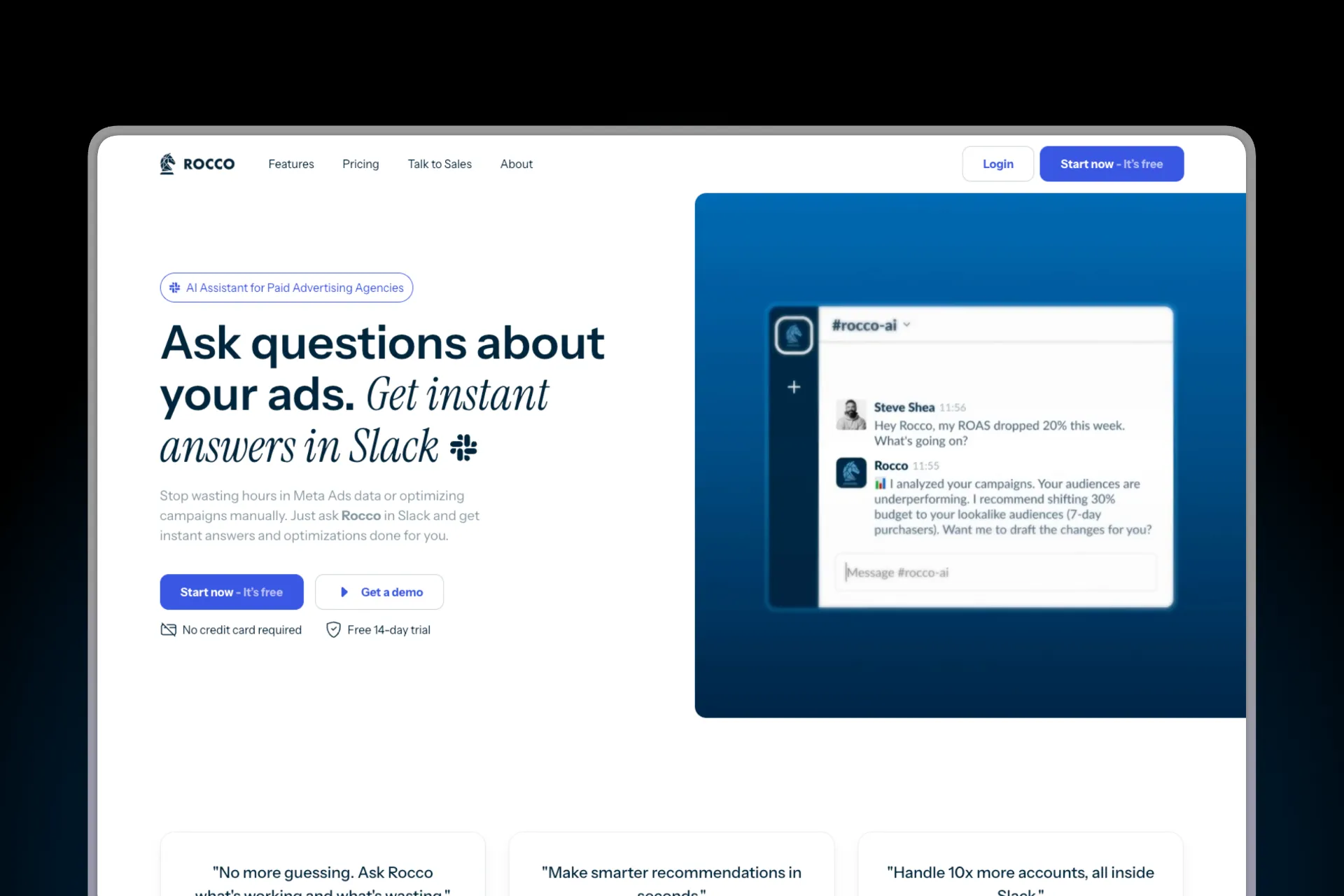
Download AskRocco — an AI assistant for Meta Ads that works inside Slack. It helps you track performance and make optimization decisions without bouncing between dashboards.
AskRocco is our #1 tool for managing our own Meta Ads.
High Budget Ad Strategy
Create 15 ad creatives and split them across 3 ad sets within the same Meta campaign. Let Meta find the winners over 7-10 days. Pull the top performers and move them into a separate scaling campaign with higher budget. Cut everything else. Repeat the creative testing cycle in the original campaign.
The principle is the same at any budget: isolate variables, test systematically, scale winners, kill losers. Never scale a campaign before you know what's working.
Landing Pages: Your Conversion Lever
Your ads and outreach are only as good as the page people land on. This is where most SaaS product launch strategies break down.
Create Dedicated Landing Pages
Don't send paid traffic or outreach clicks to your homepage. Your homepage tries to do too many things for too many audiences. A dedicated landing page does one thing: converts one specific audience on one specific offer.
If you're running ads to founders who are struggling with demo conversions, the page should speak directly to that problem, make one offer, and remove all navigation and footer links that could pull someone away before they convert.
Get our free landing page checklist that helps you instantly create high-converting landing pages.
If you're optimizing for demos, learn how to write demo page headlines that actually convert in this free guide.
A/B Test From Day One
Your first landing page is a hypothesis. The only way to know if it's right is to test it.
Use Mida.so to run split tests directly on your landing page without touching your code. Test one variable at a time: headline first, then CTA copy, then form length. Your success metric is conversions, not time on page.
How long to run each test depends on your traffic:
- High traffic: Run tests for 1-2 weeks before calling a winner.
- Low traffic: Run tests for 3-5 weeks to reach statistical significance.
The biggest benefit of A/B testing your landing page: winning messaging carries directly into your ads and cold outreach scripts. A headline that lifts CVR by 20% on your landing page will do the same in an ad or email subject line.
Post-Launch: Where Most Founders Give Up Too Early
Going live is not the end. The founders who build predictable revenue treat post-launch as an ongoing optimization process, not a coast.
Run A/B tests on your landing page continuously. Test a new ad creative every 2-3 days. Update your cold outreach script weekly or bi-weekly based on reply data. Track all of it in a simple spreadsheet: ad performance, outreach response rates, landing page CVR, demo-to-close rate, MRR.
Record every demo call. Watch them back. Note where prospects hesitate, what questions come up repeatedly, and what language they use to describe their problem. Use these insights to update your messaging and sharpen your pitch.
Find your biggest drop-off point in the funnel and build a plan to fix it. Not five points — one. The biggest one. Fix it, measure the impact, then move to the next.
If your SaaS is B2B, post on LinkedIn every single day. Short posts: one insight, one observation, one thing you learned from a customer conversation. Consistency beats production quality at this stage. You're building an audience and trust with the exact people your ads are reaching.
Bonus: How to Supercharge Your Launch With Our Go-To-Market Kit
Building everything above from scratch takes time most founders don't have. Our SaaS Go-To-Market Kit is built for exactly this stage: early-stage SaaS founders who need a high-converting funnel live in 21 days.
The kit includes a high-converting landing page, a demo or signup funnel (your choice), sales-focused copy written for your ICP, launch-ready A/B tests, and conversion tracking setup, all done for you.